
Written by
Alan Bellows on 17 July 2008
In scores of science fiction stories, hapless adventurers find themselves unwittingly introduced to the
vacuum of space without proper protection. There is often an alarming cacophony of screams and gasps as the increasingly bloated
humans writhe and spasm. Their exposed veins and eyeballs soon bulge in what is clearly a disagreeable manner. The ill-fated adventurers rapidly swell like over-inflated balloons, ultimately bursting in a gruesome spray of blood.
As is true with many subjects, this representation in
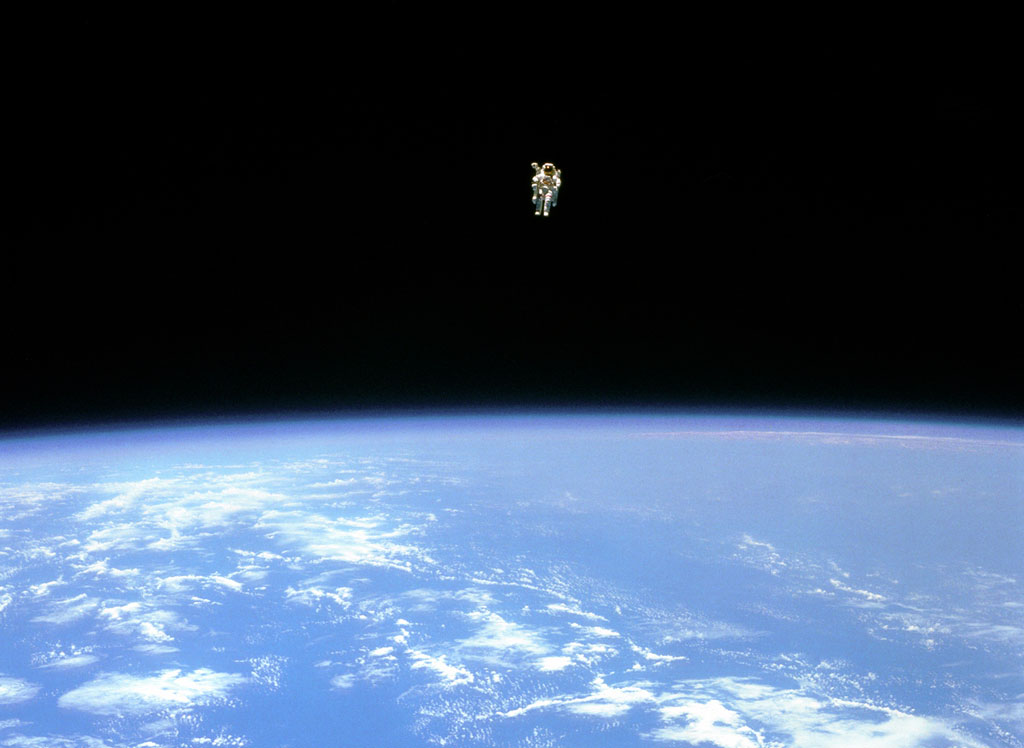
popular culture does not reflect the reality of exposure to outer space. Ever since humanity first began to probe outside of our protective atmosphere, a number of live organisms have been exposed to vacuum, both deliberately and otherwise. By combining these experiences with our knowledge of outer space, scientists have a pretty clear idea of what would happen if an unprotected human slipped into the cold, airless void.
In the 1960s, as technology was bringing the prospect of
manned spaceflight into reality, engineers recognized the importance of determining the amount of time astronauts would have to react to integrity breaches such as a damaged spacecraft or punctured space-suits. To that end, NASA constructed an assortment of large
altitude chambers to mimic the hostile environments found at varying distances above the Earth, accounting for factors such as air pressure, temperature, and radiation. Adventurous volunteers were subjected to simulations of the conditions found several miles up, and a handful of animal tests were conducted with even lower pressures.
Using the data from these experiments and their knowledge of outer space, scientists were able to make some reasonable conclusions about how the human body would respond to sudden depressurization. A series of accidents over the years proved most of their extrapolations to be accurate. In 1965, in a space-
suit test gone awry, a technician in an altitude chamber was exposed to a hard vacuum. The defective suit was unable to hold pressure, and the man collapsed after fourteen seconds. He regained consciousness shortly after the chamber was repressurized, and he was uninjured. In a later incident, another technician spent four minutes trapped at low pressure by a malfunctioning altitude chamber. He lost consciousness and began to turn blue, but escaped death when one of the managers kicked in one of the machine’s glass gauges, allowing air to seep into the chamber.
 Artist’s rendering of a Soviet Soyuz spacecraft
In 1971, three Russian cosmonauts aboard an early Soyuz spacecraft tragically experienced the vacuum of space first-hand, as described in the
Almanac of Soviet Manned Space Flight:
“…the orbital module was normally separated by 12 pyrotechnic devices which were supposed to fire sequentially, but they incorrectly fired simultaneously, and this caused a ball joint in the capsule’s pressure equalization valve to unseat, allowing air to escape. The valve normally opens at low altitude to equalize cabin air pressure to the outside air pressure. This caused the cabin to lose all its atmosphere in about 30 seconds while still at a height of 168 km. In seconds, Patsayev realized the problem and unstrapped from his seat to try and cover the valve inlet and shut off the valve but there was little time left. It would take 60 seconds to shut off the valve manually and Patsayev managed to half close it before passing out. Dobrovolsky and Volkov were virtually powerless to help since they were strapped in their seats, with little room to move in the small capsule and no real way to assist Patsayev. The men died shortly after passing out. [...] The rest of the descent was normal and the capsule landed at 2:17 AM. The recovery forces located the capsule and opened the hatch only to find the cosmonauts motionless in their seats. On first glance they appeared to be asleep, but closer examination showed why there was no normal communication from the capsule during descent.”
When the human body is suddenly exposed to the vacuum of space, a number of injuries begin to occur immediately. Though they are relatively minor at first, they accumulate rapidly into a life-threatening combination. The first effect is the expansion of gases within the lungs and
digestive tract due to the reduction of external pressure. A victim of
explosive decompression greatly increases their chances of survival simply by exhaling within the first few seconds, otherwise death is likely to occur once the lungs rupture and spill bubbles of air into the circulatory system. Such a life-saving exhalation might be due to a shout of surprise, though it would naturally go unheard where there is no air to carry it.
In the absence of
atmospheric pressure water will spontaneously convert into vapor, which would cause the moisture in a victim’s mouth and eyes to quickly boil away. The same effect would cause water in the muscles and soft tissues of the body to evaporate, prompting some parts of the body to swell to twice their usual size after a few moments. This bloating may result in some superficial bruising due to broken capillaries, but it would not be sufficient to break the skin.
 A NASA altitude chamber
Within seconds the reduced pressure would cause the nitrogen which is dissolved in the blood to form gaseous bubbles, a painful condition known to divers as “the bends.” Direct exposure to the sun’s ultraviolet radiation would also cause a severe sunburn to any unprotected skin. Heat does not transfer out of the body very rapidly in the absence of a medium such as air or water, so freezing to death is not an immediate risk in outer space despite the extreme cold.
For about ten full seconds– a long time to be loitering in space without protection– an average human would be rather uncomfortable, but they would still have their wits about them. Depending on the nature of the decompression, this may give a victim sufficient time to take measures to save their own life. But this period of “useful consciousness” would wane as the effects of brain asphyxiation begin to set in. In the absence of air pressure the
gas exchange of the lungs works in reverse, dumping oxygen out of the blood and accelerating the oxygen-starved state known as
hypoxia. After about ten seconds a victim will experience loss of vision and impaired judgement, and the cooling effect of evaporation will lower the temperature in the victim’s mouth and nose to near-freezing. Unconsciousness and convulsions would follow several seconds later, and a blue discoloration of the skin called
cyanosis would become evident.
At this point the victim would be floating in a blue, bloated, unresponsive stupor, but their brain would remain undamaged and their heart would continue to beat. If pressurized oxygen is administered within about one and a half minutes, a person in such a state is likely make a complete recovery with only minor injuries, though the hypoxia-induced blindness may not pass for some time. Without intervention in those first ninety seconds, the blood pressure would fall sufficiently that the blood itself would begin to boil, and the heart would stop beating. There are no recorded instances of successful resuscitation beyond that threshold.
Though an unprotected human would not long survive in the clutches of outer space, it is remarkable that survival times can be measured in minutes rather than seconds, and that one could endure such an inhospitable environment for almost two minutes without suffering any irreversible damage. The human body is indeed a resilient machine.


![Reblog this post [with Zemanta]](https://lh3.googleusercontent.com/blogger_img_proxy/AEn0k_sy1cA97rmYQx9EhxNYUqfY-CZBs_vHBzT7E8wUkwcBEhY9vzchvNiYmgCDLW8jWCDhtyazVIuTW9CDy_nOPl00V3OtalqnHc3XbPqezQ8CBfCCiM90UH2HdTs5GP2G3J0hru02lNqVdXPHe8oeUBaA=s0-d)

![Reblog this post [with Zemanta]](https://lh3.googleusercontent.com/blogger_img_proxy/AEn0k_uXx8cPkmeqPB3wqvNrV7kvb8cW_31hAWHATSf4XWHYkUzftWcZE3KR69u1cq2WChz4TFmxQqu1XrZMbnet6ege26nK2QStiYqsVXWllDsEUn4z5b4f9u0kGPz0D39DYeByP-G3GdDUXpiBugcP2Q4=s0-d)


![Reblog this post [with Zemanta]](https://lh3.googleusercontent.com/blogger_img_proxy/AEn0k_uAZc4dx1miKy4zyAioJV1_DP-klCeWeHpAqp1uYmkPdfnz9O2M44SXyzLlnJUsPpDXVZj6ov51dCMC2T_8ygsVY-BwphaZamOZFFaD1SxjoLaJr_2O6Z50aMrgvyxQ1KPh_dtBuV7uU36SALI_lxgz=s0-d)
 Gregg Braden is a leading authority on bridging the wisdom of our past with the science,
 ![Reblog this post [with Zemanta]](https://lh3.googleusercontent.com/blogger_img_proxy/AEn0k_vzOOzYdl2_s5m1bhJv-WcKG4nNBeCWa_VzDggmamDuEpP_EYD-o2UVUyDa5xqiIBLE2tdndSfH4ZM6YyDooVz1Ik_GfIHONNBdKb2q6c70cnw-bSr0dPQOYTj6s7_hgF40doTK4VxWDoBz5A7bD1jN=s0-d)


![Reblog this post [with Zemanta]](https://lh3.googleusercontent.com/blogger_img_proxy/AEn0k_tHUrR5Qw8dHZkMW7dYrhtkIK2qgYIdg9CKl0sCQDgjov5HfNdr1zMoO_V1UBvp-8UmuochDmuwYKRs94uQmtUyk0VZematS60N9rfkn7S_2B2f5Ic_x30FXG6-LtRg_8ZM8D-eHC5kwgMB6dx8I-8f=s0-d)
![Reblog this post [with Zemanta]](https://lh3.googleusercontent.com/blogger_img_proxy/AEn0k_uLDoBJR24kveeMFFNWH17hKFCDfQ93ELGEtgiOS-QyLIVa3pjLH0Qw3bFgNtrXD1uVXRQKc3Lro7NH6MEYPDdHWfwf4bnjTRx7qMoYjgXwyCcRBVdXxHuJA3iilVZFWTE2C3TZ4jqJTItyOH9XxPU=s0-d)

![Reblog this post [with Zemanta]](https://lh3.googleusercontent.com/blogger_img_proxy/AEn0k_tkUN7_FXLrU6tceW8QnqpeU7AfWWufFmaEi598NfM7BzXd4MUzCsPN4lNzOvGMbrszZH0cauSg9bH9nU6wx8XQurdaVQK9phRwNaKXIePRq5gF6hVLuUfUWbrMCHDN5Jb0W7tBxYZsDD-0nBoXeRYM=s0-d)

![Reblog this post [with Zemanta]](https://lh3.googleusercontent.com/blogger_img_proxy/AEn0k_s8AR39_7VwplLEFvueYgQkYvhHiUrSd5-EXl0HmCUulWIduGh92WaluNAJinHCLFFbaG6neZ1OeepY0PnPxMcyhmg_VOdK87gviXr57S9Qh3AbS6K_ZqaGOWF8sq1Nu08MNZ4eIRq0hRXjiROAVcvu=s0-d)
![Reblog this post [with Zemanta]](https://lh3.googleusercontent.com/blogger_img_proxy/AEn0k_vMkdJiGafAWphoJLKG_4HGVBcpPx6zdDobd0WKVOp9diWZSPlau9kokoOl2oo-CCDSFtTihaLg1-wXo1c5R9JHVyFns5nLR3Aon9dGhL5rqNHpzRkQ84Xz_mqNUe-SRAL6n_p9WAjr0aOfdRNMVZs=s0-d)