A science program about the possiblilty of Time Travel with Dr David Deutsch.
What remains of the killing-your-earlier-self paradox in general relativistictime travel worlds is the fact that in some cases the states on edgeless spacelike surfaces are ‘overconstrained’, so that one has less than the usual freedom in specifying conditions on such a surface, given the time-travel structure, and in some cases such states are ‘underconstrained’, so that states on edgeless space-like surfaces do not determine what happens elsewhere in the way that they usually do, given the time travel structure. There can also be mixtures of those two types of cases. The extent to which states are overconstrained and/or underconstrained in realistic models is as yet unclear, though it would be very surprising if neither obtained. The extant literature has primarily focused on the problem of overconstraint, since that, often, either is regarded as a metaphysical obstacle to the possibility time travel, or as an epistemological obstacle to the plausibility of time travel in our world. While it is true that our world would be quite different from the way we normally think it is if states were overconstrained, underconstraint seems at least as bizarre as overconstraint. Nonetheless, neither directly rules out the possibility of time travel.
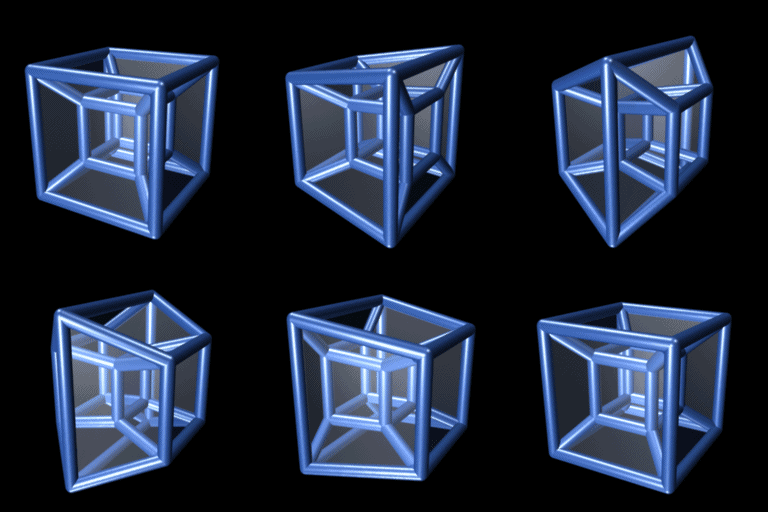
In physics and mathematics, a sequence of n numbers can be understood as a location in an n-dimensional space. When n = 4, the set of all such locations is called 4-dimensional Euclidean space.
Such a space differs from our more familiar three-dimensional space in that it has an additional dimension, indistinguishable from the other three. This fourth spatial dimension is a concept distinct from the time dimension in spacetime, since time is functionally very different from any of the spatial dimensions; formally, spacetime is not an Euclidean space but a Minkowski space.
Carl Sagan explains the concept of the 4th dimension in easy to understand terms.
Some theories, most notably special and general relativity, suggest that suitable geometries of spacetime, or specific types of motion in space, might allow time travel into the past and future if these geometries or motions are possible.[10] In technical papers, physicists generally avoid the commonplace language of "moving" or "traveling" through time ('movement' normally refers only to a change in spatial position as the time coordinate is varied), and instead discuss the possibility of closed timelike curves, which are worldlines that form closed loops in spacetime, allowing objects to return to their own past. There are known to be solutions to the equations of general relativity that describe spacetimes which contain closed timelike curves (such as Gödel spacetime), but the physical plausibility of these solutions is uncertain.
Physicists take for granted that if one were to move away from the Earth at relativistic velocities and return, more time would have passed on Earth than for the traveler, so in this sense it is accepted that relativity allows "travel into the future" (although according to relativity there is no single objective answer to how much time has 'really' passed between the departure and the return). On the other hand, many in the scientific community believe that backwards time travel is highly unlikely. Any theory which would allow time travel would require that issues of causality be resolved. The classic example of a problem involving causality is the "grandfather paradox": what if one were to go back in time and kill one's own grandfather before one's father was conceived? But some scientists believe that paradoxes can be avoided, either by appealing to the Novikov self-consistency principle or to the notion of branching parallel universes.
The Tevatron
At Fermilab’s Tevatron, physicists study such exotic phenomena as extra dimensions, paving the way for scientific discoveries.
The revolutionary concept of string theory is a bold realization of Einstein's dream of an ultimate explanation for everything from the tiniest quanta of particle physics to the cosmos itself. String theory unifies physics by producing all known forces and particles as
different vibrations of a single substance called superstrings. String theory brings quantum consistency to physics with an elegant mathematical construct that appears to be unique.
Do superstrings exist?
The strings themselves are probably too tiny to observe directly, but string theory makes a number of testable predictions. It implies supersymmetry and predicts seven undiscovered dimensions of space, dimensions that would give rise to much of the mysterious complexity of particle physics. Testing the validity of string theory requires searching for the extra dimensions and exploring their properties. How many are there? What are their shapes and sizes? How and why are they hidden? And what are the new particles associated with the extra dimensions?
to travel from one parallel universe to an adjacent one. A wormhole which connects (usually closed) universes is called a Schwarzschild wormhole. In string theory, a wormhole has been envisioned to
connect two D-branes, where the mouths are attached to the branes and are connected by a flux tube. If a brane is in fact a universe, this would make perfect sense. Also wormholes are believed to be a part of space-time foam. There are two main types of wormholes: Lorentzian wormholes and Euclidean wormholes.
..Lorentzian wormholes are a product of general relativity and semi-classical gravity, but Euclidean wormholes are studied in particle physics. Interestingly, traversable wormholes (a special kind of Lorentzian wormhole) could possibly allow a human to travel from one side of the wormhole to the other. It would certainly allow a cross transmission of EMF or other forms of pure energy.
..Lorentzian wormholes are not excluded within the framework of general relativity, but the physical plausibility of their existence has remained elusive. It is also unknown whether a theory of quantum gravity, merging general relativity with quantum mechanics, would still allow them, but I suspect they would. Most of the accepted solutions of general relativity which allow for traversable wormholes require the existence of exotic matter, a theoretical substance which would have to have a negative energy density. However, it has not been mathematically proven that this is an absolute requirement for traversable wormholes, nor has it been established that exotic matter cannot exist.
Exotic matter is a hypothetical concept of particle physics. It covers any material which violates one or more classical conditions or is not made of known baryonic particles. Such materials would possess qualities like negative mass or being repelled rather than attracted by gravity. The closest known real representative of exotic matter is a region of pseudo-negative pressure density produced by the Casimir effect. In physics, the Casimir effect and the Casimir-Polder force are physical forces arising from a quantized field. The typical example is of two uncharged metallic plates in a vacuum, placed a few micrometers apart, without any external electromagnetic field.
Scientists discuss what sort of life could be found in the eleventh dimension. With talk of world of lightning bolts, electricity, unstable atoms and more, this video from BBC show 'Parallel Universe' is full of mind-bending theories.
![Reblog this post [with Zemanta]](https://lh3.googleusercontent.com/blogger_img_proxy/AEn0k_tL0X-NKeFM9WOnzP0YZ26v7FXHdM7pcMd5kHHq3ZE6GFdROURLgLWTJbiXum6RMkbgsbF3tjOl8aQaYV0UPftsxAUczPr9_9Aem-HN9zVPG9MQOD6R9PoEEpEnicye5vNsTScAxqlmlqQ5pMDMjWQ=s0-d)

![Reblog this post [with Zemanta]](https://lh3.googleusercontent.com/blogger_img_proxy/AEn0k_vlQf8wT2L5GJDE0WR4gl8uvWbDXOALdaR8YCipVkeCaWYxItmTymGmj7Z0Yeo1P86_PUd9FkcJZ68rpkVVVtiDTrBKnZLtNreSbQ2Sgn1gG2-TiYsmtb0LMtcSstqQMogbBEtVVz6Vpp7FZt0c_A8=s0-d)

![Reblog this post [with Zemanta]](https://lh3.googleusercontent.com/blogger_img_proxy/AEn0k_so-wjW-vgq4f4QzIThr3JTi7DIMc2P0e2c6MR1pnCKieJf0HBsbxP2R-fLy9jXQ2s9wuCW-OzbhxeZicAIzG8NYZr-of7DWqs5oNRqe5EEE6yuq1scRhpVv8e2R7JwHrS7GDvx_DETfCYeQI4vVEJ7=s0-d)


![Reblog this post [with Zemanta]](https://lh3.googleusercontent.com/blogger_img_proxy/AEn0k_u6WYYMez8hm5PFbsSdlwdb8sm0DOiF_J37sQndYVvhH7knQuoQ8Wi7e6v3f_Qpxtd8FxPw1PagahN_I5Lw8rTUCeKGm1gD_fQHRIwse43EW4Cb_sCC5BpmbppM_IEwhw3WHFVVtJNBjvX64mTPbdDg=s0-d)