Showing posts with label physics. Show all posts

Saturday, April 3, 2010

Multiplying universes: How many is the multiverse?

http://astroweb1.physics.ox.ac.uk/~philcosmo2009/images/multiverse7.jpg

Multiplying universes: How many is the multiverse?

by Amanda Gefter

HOW many universes are there? Cosmologists Andrei Linde and Vitaly Vanchurin at Stanford University in California calculate that the number dwarfs the 10500 universes postulated in string theory, and raise the provocative notion that the answer may depend on the human brain.

The idea that there is more than one universe, each with its own laws of physics, arises out of several different theories, including string theory and cosmic inflation. This concept of a "multiverse" could explain a puzzling mystery - why dark energy, the furtive force that is accelerating the expansion of space, appears improbably fine-tuned for life. With a large number of universes, there is bound to be one that has a dark energy value like ours.

Calculating the probability of observing this value - and other features of the cosmos - depends on how many universes of various kinds populate the multiverse. String theory describes 10500 universes, but that just counts different vacuum states, which are like the blank canvases upon which universes are painted. The features of each canvas determine what the overall painting will look like - such as the laws of physics in that universe - but not the details.

Thanks to the randomness of quantum mechanics, two identical vacuum states can end up as very different universes. Small quantum fluctuations in the very early universe are stretched to astronomical scales by inflation, the period of faster-than-light expansion just after the big bang. These fluctuations lay down a gravitational blueprint that eventually determines the placement of stars and galaxies across the sky. Small differences in the form of these fluctuations can produce a universe in which the Milky Way is slightly bigger, or closer to its neighbours.


So just how many of these different universes can inflation's quantum fluctuations produce? According to Linde and Vanchurin, the total is about 101010,000,000 - that's a 10 raised to a number ending with 10 million zeros (arxiv.org/abs/0910.1589). Suddenly string theory's multiverse of 10500 universes is looking rather claustrophobic.

It might be, however, that this number is irrelevant, and that in a world ruled by quantum physics what matters is how many universes a single observer can distinguish. "Before quantum mechanics," says Linde, "we thought that 'reality' was a well-defined word." In classical physics, observers are irrelevant - we simply want to know how many universes exist.
It may not matter how many universes exist - just how many a single observer can tell apart

According to quantum physics, observers affect the systems they measure (see "Restricted view"). If observers are an integral part of the cosmic formula, then it may not matter how many universes exist - just how many a single observer can tell apart. If the observer is a person, that depends on how many bits of information the brain can process. "Based on the number of synapses in a typical brain, a human observer can register 1016," says Linde. That means humans can differentiate 101016 universes, which is much more manageable than the 101010,000,000 Linde and Vanchurin found to start with.

But does the human brain really play a role in making predictions in the multiverse? "This goes deep into philosophy," Linde says. "It's a slippery slope."
http://neuronarrative.files.wordpress.com/2009/03/brain_000005809739xsmall.jpg

Cosmologist Alex Vilenkin of Tufts University in Boston is equally ambivalent. "It could be right that what is important is what an observer sees," he says. "But there might be things an observer doesn't see that are still there."

Restricted view

Quantum theory splits the world into two parts: the system under study and the rest of the world, which contains the observer. The system hovers in a ghostly state of near-existence made up of a host of possibilities until the observer makes a measurement - and so reduces this to a single reality.

Cosmology suffers from the paradox that no observer can be outside the universe - so the universe is doomed to spend eternity as nothing more than a vague possibility. The lesson of quantum cosmology is that we can't talk about the universe as a whole, but only what a given observer inside it might measure. Applying that lesson to the multiverse, Andrei Linde and Vitaly Vanchurin suggest that what matters is not the total number of possible universes, but the number of universes a single observer could distinguish.


If that observer is a human, the brain limits the amount of information they can register. But any observer - even an inanimate one such as a galaxy - is limited in the information it can store. These limitations in what observers can measure whittle down the number of universes that come into play in cosmological predictions. That means an observer might make a difference in explaining the value of things like dark energy.


World Science Festival 2009: Infinite Worlds, Part 3 of 6 from World Science Festival on Vimeo.


Reblog this post [with Zemanta]

Intention & Retrocausality

http://www.fortedownloads.com/image/clock-desktop-com-Atomic-Clock-ScreenSaver.png

Cause and effect is pretty easy to understand. I pick up a remote control, press the power button and my TV turns on. Me pressing the power button is the cause, the TV turning on is the effect. We all learned about it in grade school.

But what if that were reversed? What if my TV turned on, and that caused me in the past to press the power button on the remote control? It goes against everything we think we know about the way the universe works, but that is the essence of the theory of retrocausality. The effect
creates the cause. It sounds like something straight out of the pages of science fiction, but many scientists today believe that retrocausality could be a real phenomenon.

From wikipedia: Retrocausality (also called retro-causation, backward causation and similar terms) is any of several hypothetical phenomena or processes that reverse causality, allowing an effect to occur before its cause.

According to Paul March from a Talk Polywell comment: Dr. Cramer's retrocausal experiment should be completed by the end of this year. And if verified it would buttress Dr. Woodward's M-E (Mach Effect) arguments and provide a path to finally merging GRT (General relativity) with QM (Quantum Mechanics).

A 36 page presentation from 2007: The UW Nonlocal Quantum Communication Experiment by John Cramer

Entanglement: The separated but “entangled” parts of the same quantum system can only be described by referencing the state of other part.
The possible outcomes of measurement M2 depend of the results of measurement M1, and vice versa. This is usually a consequence of conservation laws.
http://philosopherpoet.files.wordpress.com/2009/01/timewarp.jpg

Nonlocality: This “connectedness” between the separated system parts is called quantum nonlocality. It should act even of the system parts are separated by light years. Einstein called this “spooky actions at a distance.”


Physicist York Dobyns explains retrocausality -- how human intentions affect the past; discusses Cal Tech Physicist Kip Thorne's theories of wormholes on the fabric of space and time; and touches upon some of the strange implications of our current understanding of quantum mechanics. Interview by Tom Munnecke at the American Association for the Advancement of Science at University of San Diego on June 23, 2006.


York Dobyns earned his PhD in physics at Princeton and is the Analytical Coordinator for the Princeton Engineering Anomalies Research (PEAR) program.
For more information, visit: http://www.princeton.edu/~pear/

https://blogger.googleusercontent.com/img/b/R29vZ2xl/AVvXsEgSnRSuYQSHnym6Fi0HLTPKFP9no7hV49ZhmyUHtImggoE3GpjkmGhzg4aXt5KQTlSpX7TbxG0DMkiReRAcLajJYv4Dojjj3U4Im0vsbzUYRQw1d8FoF9waRvwFQGH73GJcmzRuVkJ_h_g/s400/retro1.jpg
A Brief History of Retrocausality Experiments: 35 years ago, Helmut Schmidt pioneered studies on the effects of human intention on random event generators (REGs) — machines which generate a string of qubits that can be imagined as a stream of coins flipping in the air. Using REG data which were prerecorded and unobserved, Schmidt showed that his subjects were able to influence selected heads or tails events which had occurred up to six days earlier. More recently, Brenda Dunne and Robert Jahn (PEAR) conducted close to 87,000 similar (and statistically significant) REG/RPK experiments. Elmar Grubers retrocausation experiments (PK Effects on Pre-Recorded Group Behaviour of Living Systems European Journal of Parapsychology, 3, 1980, 167-75) showed that conscious intention can seemingly influence the past activity of both animals and humans. In one of the human trials, the effect size was 0.74, which is over twenty-three times greater than the effect size of most prescription drugs (0.032). These studies — and numerous others involving everything from steel marbles to human skin conductance and heart rate — have shown the apparent effect that conscious intent has on altering events which have already occurred... Or, at least, events which have already occurred from our commonly held perspective.


Part 2: http://www.youtube.com/watch?v=bYOaQQUWk7s

Part 3: http://www.youtube.com/watch?v=AAUTs-1ukrY


Reblog this post [with Zemanta]

Origins of the Universe

At least our one "local" universe (quantum theory suggest an infinite number of them), the big bang theory is stil being debated. Sam neil hosts this doc with decent production value. worrrd.


Watch Programme 1: Star Stuff in Educational | View More Free Videos Online at Veoh.com
The multiverse (or meta-universe (metaverse)) is the hypothetical set of multiple possible universes (including our universe) that together comprise all of reality. The different universes within the multiverse are sometimes called parallel universes. The structure of the multiverse, the nature of each universe within it and the relationship between the various constituent universes, depend on the specific multiverse hypothesis considered.

and "are we alone"


Watch Programme 4: Are We Alone? in Educational | View More Free Videos Online at Veoh.com

Reblog this post [with Zemanta]

TIME TRAVEL

A science program about the possiblilty of Time Travel with Dr David Deutsch.

What remains of the killing-your-earlier-self paradox in general relativistic time travel worlds is the fact that in some cases the states on edgeless spacelike surfaces are ‘overconstrained’, so that one has less than the usual freedom in specifying conditions on such a surface, given the time-travel structure, and in some cases such states are ‘underconstrained’, so that states on edgeless space-like surfaces do not determine what happens elsewhere in the way that they usually do, given the time travel structure. There can also be mixtures of those two types of cases. The extent to which states are overconstrained and/or underconstrained in realistic models is as yet unclear, though it would be very surprising if neither obtained. The extant literature has primarily focused on the problem of overconstraint, since that, often, either is regarded as a metaphysical obstacle to the possibility time travel, or as an epistemological obstacle to the plausibility of time travel in our world. While it is true that our world would be quite different from the way we normally think it is if states were overconstrained, underconstraint seems at least as bizarre as overconstraint. Nonetheless, neither directly rules out the possibility of time travel.


Reblog this post [with Zemanta]

TIME

We've always structured our lives based on an unchanging past and a predictable and ordered future. But atomic and cosmic discoveries have changed all that. What is time itself? And will it ever end?

Michio Kaku taks about the nature of timehttp://ideafestival.typepad.com/my_weblog/images/2007/09/15/michio_kaku_2.jpg
this is the video

Reblog this post [with Zemanta]

Which way for Physics?

http://www.aub.edu.lb/sao/activities/PublishingImages/org/logo/physics_logo.jpg
by kellyneill
An excerpt from a lecture given by Brian Josephson at the 58th Meeting of Nobel Laureates in Lindau (Germany). Armed with compelling evidence that many in the scientific community have a vested interest in discrediting new discoveries which challenge established dogma, Josephson argues that the laws of physics are the consequence of self-organization rather than being derivative of universal laws. This video is the speaker's edit of the original recording by the European Broadcasting Union.

Professor Josephson is a Welsh physicist whose discovery of the Josephson effect while a 22-year-old graduate student
http://superconductors.free.fr/images/josephson.jpg

won him a share (with Leo Esaki and Ivar Giaever) of the 1973 Nobel Prize for Physics. He was appointed Reader in Physics in 1972 and Professor of Physics in 1974. He was elected a fellow of the Royal Society in 1970. In addition to winning a Nobel Prize, Josephson is the recipient of numerous awards and medals. For more information, visit http://www.tcm.phy.cam.ac.uk/~bdj10/


Part 2: http://www.youtube.com/watch?v=dsLYGhH4Uhc

Part 3: http://www.youtube.com/watch?v=D90OZE9bULI


Reblog this post [with Zemanta]

quantum physics and consciousness

http://www.digitalworldtokyo.com/entryimages/2007/05/070504_Quantum_mechanics.jpg
A commonly debated use of the term refers to quantum mechanics, where, if the outcome of an event has not been observed, it exists in a state of 'superposition', which is akin to being in all possible states at once. In the famous thought experiment known as Schrödinger's cat the cat is supposedly neither alive nor dead until observed. However, most quantum physicists, in resolving Schrödinger's seeming paradox, now understand that the acts of 'observation' and 'measurement' must also be defined in quantum terms before the question makes sense. From this point of view, there is no 'observer effect', only one vastly entangled quantum system. A significant minority still find the equations point to an observer; Wheeler, who probably worked more deeply on this subject than any physicist thus far, devised a graphic in which the universe was represented by a "U" with an eye on one end, turned around and viewing itself, to describe his understanding.


good video about the connection between perceived reality/matter and consciousness.


The Heisenberg uncertainty principle is also frequently confused with the "observer effect". The uncertainty principle actually describes how precisely we may measure the position and momentum of a particle at the same time — if we increase the precision in measuring one quantity, we are forced to lose precision in measuring the other. Thus, the uncertainty principle deals with measurement, and not observation. The idea that the Uncertainty Principle is caused by disturbance (and hence by observation) is not considered to be valid by some, although it was extant in the early years of quantum mechanics, and is often repeated in popular treatments.

http://bestherbalcures.com/images/mind_over_matter02_1.jpg

There is a related issue in quantum mechanics relating to whether systems have pre-existing — prior to measurement, that is — properties corresponding to all measurements that could possibly be made on them. The assumption that they do is often referred to as "realism" in the literature, although it has been argued that the word "realism" is being used in a more restricted sense than philosophical realism[1]. A recent experiment in the realm of quantum physics has been quoted as meaning that we have to "say goodbye" to realism, although the author of the paper states only that "we would [..] have to give up certain intuitive features of realism" [2] [3]. These experiments demonstrate a puzzling relationship between the act of measurement and the system being measured, although it is clear from experiment that an "observer" consisting of a single electron is sufficient -- the observer need not be a conscious observer. Also, note that Bell's Theorem suggests strongly that the idea that the state of a system exists independently of its observer may be false.

http://www.archives.gov.on.ca/english/on-line-exhibits/thompson/pics/c_073573_observation_520.jpg

Note that the special role given to observation (the claim that it affects the system being observed, regardless of the specific method used for observation) is a defining feature of the Copenhagen Interpretation of quantum mechanics. Other interpretations resolve the apparent paradoxes from experimental results in other ways. For instance, the Many-Worlds Interpretation posits the existence of multiple universes in which an observed system displays all possible states to all possible observers. In this model, observation of a system does not change the behavior of the system -- it simply answers the question of which universe(s) the observer(s) is(are) located in: In some universes the observer would observe one result from one state of the system, and in others the observer would observe a different result from a different state of the system.
Reblog this post [with Zemanta]

Dark Matter

Pie chart of matter fractions in universeImage via Wikipedia

darkmatter09032

In astronomy and cosmology, dark matter is hypothetical matter that is undetectable by its emitted radiation, but whose presence can be inferred from gravitational effects on visible matter.[1] According to present observations of structures larger than galaxies, as well as Big Bang cosmology, dark matter and dark energy account for the vast majority of the mass in the observable universe. Dark matter is postulated to partially account for evidence of "missing mass" in the universe, including the rotational speeds of galaxies, orbital velocities of galaxies in clusters, gravitational lensing of background objects by galaxy clusters such as the Bullet Cluster, and the temperature distribution of hot gas in galaxies and clusters of galaxies.


Join UCSD Physicist Kim Griest as he takes you on an exploration of two of the major unsolved questions in the physical sciences: What might be the fate of the universe and what is the nature of the dark matter which ultimately decides this fate? Series: "UCSD Millennium Lectures"


Reblog this post [with Zemanta]

NANOTECHNOLOGY

http://i.treehugger.com/nanotech.jpg

Nanotechnology, shortened to "nanotech", is the study of the control of matter on an atomic and molecular scale. Generally nanotechnology deals with structures of the size 100 nanometers or smaller, and involves developing materials or devices within that size. Nanotechnology is very diverse, ranging from novel extensions of conventional device physics, to completely new approaches based upon molecular self-assembly, to developing new materials with dimensions on the nanoscale, even to speculation on whether we can directly control matter on the atomic scale.
Scientists and engineers are collaborating across disciplines to develop and network miniaturized intelligent nanosensors that can rapidly and remotely detect change in their surroundings. These sensors have a wide range of potential applications: environmental, medical, military and transportation. This workshop will focus on revealing the chemistry and physics behind the creation and application of these sensors. Series: "Molecules for the Media"


The truth about Nanotechnology

A concise introduction to what NT is, what it can't do yet and what we should be aware of Nanotechnology marks the merger of different technologies in structures smaller than 100 nm. While it could yield some powerful applications for sustainability, medicine and electronics, some hazards begin to appear that have to be addressed urgently


Watch The truth about Nanotechnology in Educational | View More Free Videos Online at Veoh.com


Reblog this post [with Zemanta]

Physics, Metaphysics & the Consciousness Connection

brain
Physicist and consciousness researcher, Thomas Campbell-His book "My Big TOE, written by a nuclear physicist in the language of contemporary Western culture, unifies science and philosophy, physics and metaphysics, mind and matter, purpose and meaning, the normal and the paranormal. The entirety of human experience (mind, body, and spirit) including both our objective and subjective worlds, are brought together under one seamless scientific understanding. Heres a lecture..


Watch Physics, Metaphysics & the Consciousness Connection in Educational | View More Free Videos Online at Veoh.com

Reblog this post [with Zemanta]

Holographic Universe

Moving toward the Consciousness [Prime Mover] The Holographic Universe is a book by Michael Coleman Talbot exploring the idea that the universe is a hologram. After examining the work of physicist David Bohm and neurophysiologist Karl Pribram, both of whom independently arrived at holographic theories or models of the universe, the book argues that a holographic model could explain various paranormal and anomalous phenomena, and provide a basis for mystical experience. https://blogger.googleusercontent.com/img/b/R29vZ2xl/AVvXsEjOaRz7mWyhwqKvO78D0-6m3dP9hUqmoPLf_TH8DS_kdjH12-g_mLU_qfvJ3VUnpaUaomLnb44upi2QhHJw3dXNhzvbgE5lUPIgLJFDIznOwVcPn2ir7QxsSJ2_5gMOIOWi1oac-sdCZ5M/s400/mandelbrot-galaxy-holographic.jpg Gregg Braden discusses the Holographic Nature of the Universe, and how everything we do affects the collective conciousneess of us all.
Almost universally, ancient texts and traditions say to us, in the language of their time, that we are part of all that we see, that we are related through a Force to the events of our world, to one another, to the processes within our bodies and the Cosmos and beyond. In our most sacred traditions, this Force is described as all-powerful, something that permeates all of Creation. It's not "out there" somewhere. It is a part of ourselves as well as a part of all that we perceive.

Now Western science, beginning in about 1993, through accredited academic and scientific institutions, has performed experiments with unexpected — and in some cases very surprising — results, experiments demonstrating that the ancient tenets appear to be true. In these experiments, the only way that the curious and bizarre behavior of nature and particles in the subatomic world, the quantum world, could be explained was if those particles were all connected through a previouisly unrecognized Force.

So what's happening right now, in the early years of the 21st Century, is that Western science is moving toward accepting the ancient idea of this unity field that links all of Creation.

Some scientists are calling this field Nature's Mind. Some scientists are calling it the Mind of God (a famous name given to it by Stephen Hawking in his book A Brief History of Time.) Many researchers now are calling it the Quantum Hologram


david icke: "We Are Infinite Consciousness Living In A Holographic Illusion"


'In a holographic universe, even time and space could no longer be viewed as fundamentals. Because concepts such as location break down in a universe in which nothing is truly separate from anything else, time and three-dimensional space, like the images of the fish on the TV monitors, would also have to be viewed as projections of this deeper order.


Reblog this post [with Zemanta]

Sunday, February 28, 2010

Magical Metamaterials

Magic lies in the beauty of a powerful illusion. This is what the latest achievements in optics seem to suggest; metamaterials are now able to optically turn one object into another.

Negative refraction. The picture on the left shows how a spoon in a glass of water appears to break at the air-water interface, and then continues inside the liquid slightly shifted to one side, but still keeping the same orientation as in air — left-to-right in this case. This optical illusion is due to the fact that the refractive index of water is different from the one of air — still positive though, as in any other natural material. On the right, there is a basic illustration of what would happen by filling the glass with a liquid with a negative index of refraction: the orientation of the spoon inside the liquid would appear to be diametrically opposite to the spoon in the air, namely right-to-left instead of left-to-right.
Concepts that have traditionally been associated with the realm of magic are now being turned into reality through science. It is no witchcraft, of course, just a very good illusion! At the Hong Kong University of Science and Technology (Hong Kong, China), it has been proposed that the right metamaterial can make one object appear like another one – exactly as it happens in an illusion show.

What if a teaspoon could look like a cup or a huge elephant like a tiny mouse? Illusion optics: the optical transformation of an object into another object is the title of the publication, where Yun Lai, Zhao-Qing Zhang, C. T. Chan and collaborators report their new findings. By illusion optics, "we mean the capability of making one object look like another one," the three researchers explain. "In short, we have designed a device that can make an object appear like another object in a specific range of frequencies. Moreover, there is no way for an observer, who can perceive only in this range, to realize that this is an illusion."

The optical illusion takes place in a two-step process: first, the image of the real object is completely deleted by the device; then, the image of a different object is generated as a substitution for the cancelled one. The two steps are carried out by two different materials: the complementary medium and the restoring medium. After the complementary medium has optically cancelled the image of the original object, the restoring medium projects the image of the second object, generating the optical illusion. By choosing the illusion object as air, one could be able to, for example, open a virtual aperture in a wall and peep through it in a noninvasive way.

The right choice of the complementary and restoring media is of fundamental importance in order for the illusion to work. Unfortunately, it happens that the right properties do not exist in known materials; this is the reason why we have to resort to metamaterials, namely manmade materials that have been engineered in order to display exotic, but useful, electromagnetic properties. "Our theory is mathematically rigorous," Lai, Zhang, and Chan explain. "There are, however, some limitations before practical implementations. The main challenge in the realization is to make some manmade material that has a negative refractive index, which is a key component in our conceptual device. At this moment, making negative-refractive index material in the microwave regime is quite feasible. It would be a big challenge to make such materials in the optical frequency range, although there have been some amazing advances in some US and European laboratories that may help realize our design in — say — the next three to five years."

The illusion device at work. The picture shows clockwise from top-left: the scattering pattern of a fish-shaped object (with a dielectric constant of 2); the scattering pattern of a star-shaped object (with a dielectric constant of 4); the cloaking of the fish-shaped object by the illusion device; and the optical transformation of the fish-shaped object into the starfish-shaped object.
Metamaterials with a negative index of refraction [1] are needed to erase the image of the first object, before the image of the second object is created in substitution by the device. Such a metamaterial can bend light in completely new and unexplored ways, making magic become reality. An example? Imagine sneaking into a room full of people without anybody noticing your presence. Thrilling, indeed. A cloak made of metamaterials could actually turn this into reality by making you invisible; it could bend the light coming from your surroundings so that an observer would not see you, but only what is behind you. This stuff is not only good for a fantasy novel, but it is actually cutting-edge science: a material which can, at one frequency in the microwaves, deflect electromagnetic radiation, thus hiding an object inside, was first experimentally demonstrated in 2006 [2]. Soon the same effect was demonstrated at optical frequencies [3-4], before the illusion device was proposed by the researchers in Hong Kong. Here though, the principle behind the illusion device is not light bending as in cloaking devices but an exact cancellation and restoration of the optical images of the two objects involved in the illusion.

Doubts about when, how, and whether similar devices will be fully functional still need to be addressed. Steven A. Cummer at Duke University (North Carolina, USA), for example, points out that "one more issue that the authors acknowledge at the very end of their publication is that they have not accounted for loss or absorption by the materials that make up their objects. We know from previous work in the past few years that for this effect to work in practice, the materials have to be made of extremely low loss materials. This is by far the biggest challenge in making the effect work in practice, and it is a big one."

Despite these concerns, the high level of fascination that similar designs evoke is unavoidable and understandable. "It is pretty amazing to think that one could simply bolt a block of material onto a wall and suddenly be able to see through it," Cummer adds. "I cannot really say what a feasible practical application might be at this point, but I would not be surprised to see something physical come out of this work in a few years. This is just one example of the amazing things we can do with the concept of transformation optics, the same concept that produced the ideas behind electromagnetic cloaking. Only five or so years ago, we would have not even imagined that this could be done." And this is precisely the magic of science.
Reblog this post [with Zemanta]

Amit Goswami on Consciousness

Materialist Science
Dr. Amit Goswami

Professor Emeritus of physics at the University of Oregon’s Institute of Theoretical Science, Dr. Goswami is a revolutionary in a growing body of renegade scientists who in recent years have ventured into the domain of the spiritual in an attempt both to interpret the seemingly inexplicable findings of their experiments... and to validate their intuitions about the existence of a spiritual dimension of life.
A prolific writer, teacher and visionary... Dr. Goswami has appeared in the movie "What the Bleep do We know?", The "Dalai Lama Renaissance", and the recently released award winning documentary "The Quantum Activist"


Reblog this post [with Zemanta]

Created Quantum Creatures

Water bears, similar to the one pictured here, can survive in a vacuum and might be made to behave like quantum objects (Courtesy: Ralph O Schill) Water bears, similar to the one pictured here, can survive in a vacuum and might be made to behave like quantum objects

Quantum weirdness could soon invade the living world, if a scheme to give a flu virus a strange double life comes off.
In quantum theory, a single object can be doing two different things at once. This so-called "superposition" is a delicate state, destroyed by any contact with the outside world. The largest objects that have been superposed so far are molecules. It is hard to put a much larger object such as a cat or human into a superposition because air molecules and photons are always bouncing off it.
But it might be possible with a small life form, according to Oriol Romero-Isart of the Max Planck Institute for Quantum Optics in Garching, Germany, and his colleagues. They hope to prove the concept with the flu virus, which exhibits some properties of life, because it can survive in a vacuum – solving the problem of pesky air molecules.

Laser hold

Their scheme would use two laser beams, whose light exerts a gentle force on matter. Where the two beams cross they form an "optical cavity" holding the virus in place.
By adjusting the frequency of the beams, the laser photons can be made to absorb the vibration energy of the trapped virus about its centre of mass until it is slowed to its lowest possible energy state. In this "ground state" the virus is ready to go into a superposition.
Sending a laser photon towards the trap should do the trick. Since a photon is a quantum entity it has more than one option open to it. Thus it will be both reflected and transmitted at the trap, putting it into a superposition.
By impinging on the virus, it forces it into a superposition of both its ground state and next vibrational energy state. Now the virus should be doing two different things at once – the equivalent of you simultaneously mowing the lawn and doing the shopping. "They have come up with a really neat experiment – inventive and I think feasible," says Peter Knight of Imperial College London.
Romero-Isart and his colleagues speculate that they could pull off the same feat with a tardigrade, or water bear, an animal less than a millimetre in size that can survive extreme temperatures and a vacuumMovie Camera for several days.
http://www.cod.edu/people/faculty/bradley/index_files/quantum-image%5B1%5D.jpg

Big questions

Making a living thing do two things at once is more than a physicist's tour de force. It could answer fundamental questions about the nature of quantum theory.
Most physicists believe that the reason quantum behaviour manifests itself only in small things is that objects are difficult to isolate from their surroundings. But the prominent physicist Roger Penrose of the University of Oxford believes instead that there is a critical size, or mass, at which bodies cease to become quantum.
According to Knight, experiments of the kind proposed by Romero-Isart's team could finally offer a way to distinguish between the mainstream view and Penrose's.


Reblog this post [with Zemanta]

Saturday, February 27, 2010

Fractal Geometry / Electromagnetism / Golden Ratio

http://www.its.caltech.edu/~atomic/snowcrystals/class/w041219b055.jpg
 (image of an actual snowflake)

Relativity's replacement announced by Dan Winter - "The Word 'Relativity' is obsolete to describe the relationship of mass to energy because that relationship (which allows charge to compress and thus be called MASS) is more precisely FRACTAL.

 Thus geometric self-similarity perfected (Golden Ratio) allows charge (energy) to compress (non destructively) and thus become MASS. Fractality (of charge) creates MASS , life force, and self-organization (because that is what permits implosion). That Fractal path permitting non-destructive charge compression simultaneously produces charge ACCLERATION -(recursion in velocity heterodynes) which is the only source of the phenomenon called GRAVITY. The rotation of energy which stores the inertia called mass - which is also our only definition of time - is always only held in place by the centripedal charge force (gravity) caused by fractal self-similarity - being the only way any wave system (time or space) emerges from chaos."


In mathematics and the arts, two quantities are in the golden ratio if the ratio of the sum of the quantities to the larger one equals the ratio of the larger one to the smaller. The golden ratio is an irrational mathematical constant, approximately 1.6180339887. Other names frequently used for the golden ratio are the golden section (Latin: sectio aurea) and golden mean. Other terms encountered include extreme and mean ratio, medial section, divine proportion, divine section (Latin: sectio divina), golden proportion, golden cut, golden number, and mean of Phidias. The golden ratio is often denoted by the Greek letter phi, usually lower case (φ).
The figure on the right illustrates the geometric relationship that defines this constant. Expressed algebraically:
 \frac{a+b}{a} = \frac{a}{b} = \varphi\,.


Reblog this post [with Zemanta]

World's First Time Machine

http://blog.rifftrax.com/wp-content/photos/Time_Machine__1960_.jpg

From: kellyneill

In this Discovery Science documentary "The First Time Machine," Physics professor Ronald Mallett, PhD reveals that he is on the brink of making time travel a reality. His book, "Time Traveler" has garnered interest from both the scientific community and the general public and funding for his program, known as The Space-time Twisting by Light (STL) project, is progressing.

Full details on the time machine project, Mallett's theories, and a list of upcoming public lectures and links to popular articles on his work can be found at the professor's University of Connecticut web page at http://www.phys.uconn.edu/~mallett/main/main.htm


Part 2: http://www.youtube.com/watch?v=mcmmPxD2BY0

Part 3: http://www.youtube.com/watch?v=hztOphFKRJI

Part 4: http://www.youtube.com/watch?v=JPk7imosxRg

Part 5: http://www.youtube.com/watch?v=t2ceTDHaGRQ

Reblog this post [with Zemanta]

Monday, January 11, 2010

4th Dimesion for Dummies

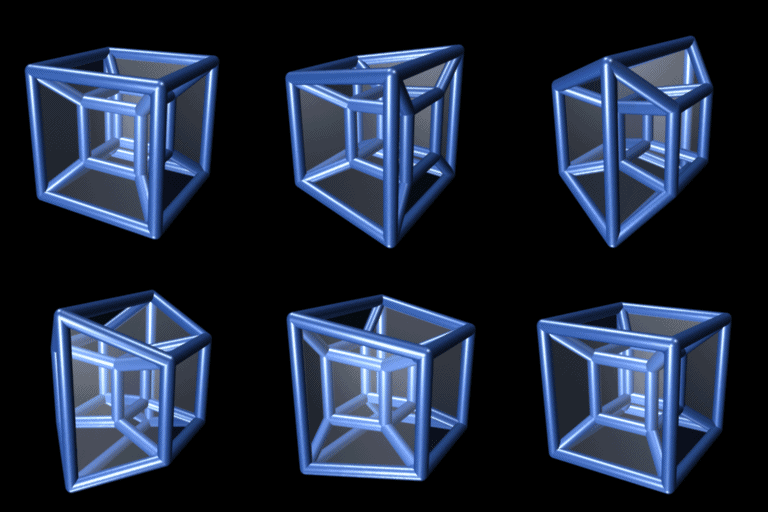
File:8-cell-simple.gif

In physics and mathematics, a sequence of n numbers can be understood as a location in an n-dimensional space. When n = 4, the set of all such locations is called 4-dimensional Euclidean space.

Such a space differs from our more familiar three-dimensional space in that it has an additional dimension, indistinguishable from the other three. This fourth spatial dimension is a concept distinct from the time dimension in spacetime, since time is functionally very different from any of the spatial dimensions; formally, spacetime is not an Euclidean space but a Minkowski space.

Carl Sagan explains the concept of the 4th dimension in easy to understand terms.


Reblog this post [with Zemanta]